

Index of Contents
As I leaned in close, my breath caught in my throat. The vibrant green katydid perched on a leaf suddenly transformed into a world of intricate details. Its compound eyes gleamed like polished emeralds, and delicate hairs adorned its legs like miniature forests. This moment sparked my passion for macro insect photography, revealing a hidden universe teeming with life and beauty.
We live in a world where the smallest creatures often go unnoticed. Yet, through the lens of macro photography, we can unveil the extraordinary in the ordinary. Close-up photography allows us to capture nature shots that showcase the incredible diversity of insects in stunning detail. From the iridescent wings of a dragonfly to the complex patterns on a butterfly’s scales, macro insects become works of art when viewed up close.
Our journey into the realm of macro insect photography promises to be both challenging and rewarding. We’ll explore the techniques and equipment needed to capture these tiny marvels in their natural habitats. By mastering this art form, we can create images that not only educate but also inspire a deeper appreciation for the often-overlooked insect world around us.
Key Takeaways
- Macro photography reveals intricate details of insects invisible to the naked eye
- Close-up shots showcase the beauty and complexity of the insect world
- Specialized equipment and techniques are essential for capturing stunning macro insect images
- Macro photography can inspire greater appreciation for often-overlooked creatures
- Nature shots of insects can serve both educational and artistic purposes
Getting Started with Macro Insect Photography
Macro insect photography opens up a world of tiny details. We’ll look at the key gear and techniques for capturing close-up shots of these tiny wonders.
Essential Equipment for Close-up Shots
To begin our macro insects journey, we need special gear. A camera with manual settings is key for controlling how bright or dark the image is. A macro lens lets us get very close to our subjects. And a tripod helps take sharp pictures by keeping the camera steady.
Understanding Macro Lens Basics
Macro lenses are made for extreme close-ups, showing things life-size on the camera sensor. When picking a macro lens, think about the focal length and how close you can get to your insects. This affects your shooting style.
Selecting the Right Camera Settings
Knowing how to set your camera is crucial for macro insect photos. We balance aperture, shutter speed, and ISO for clear, bright images. A wide aperture makes the background blurry, while fast shutter speeds stop movement. Higher ISOs help in low light.
| Setting | Typical Range | Effect |
|---|---|---|
| Aperture | f/8 – f/16 | Balances depth of field and sharpness |
| Shutter Speed | 1/60 – 1/250 | Reduces motion blur |
| ISO | 100 – 800 | Adjusts for lighting conditions |
With these tips and techniques, we’re set to capture the world of insects in detail. Remember, practice and patience are important for getting better at macro photography.
Macro Insects: Techniques for Capturing Stunning Details
To capture amazing shots of tiny creatures, you need special skills. We’ll share key tips for macro insects photography. These tips will help you make images that show the detailed beauty of these small subjects.
Mastering Depth of Field in Insect Photography
In macro photography, the depth of field is very narrow. To make sure your whole subject is sharp, try different aperture settings. A smaller aperture means a deeper depth of field but might need longer shutter times.
For sharper images, focus stacking is a good option. This means taking several shots at different focus points and then combining them later.
Lighting Techniques for Macro Insect Shots
Good lighting is key for showing off insects’ fine details. Natural light is great outdoors, but sometimes you need more control. Ring lights or macro flash units can light up your subject evenly.
Try using diffused light to soften shadows and highlight textures in your shots.
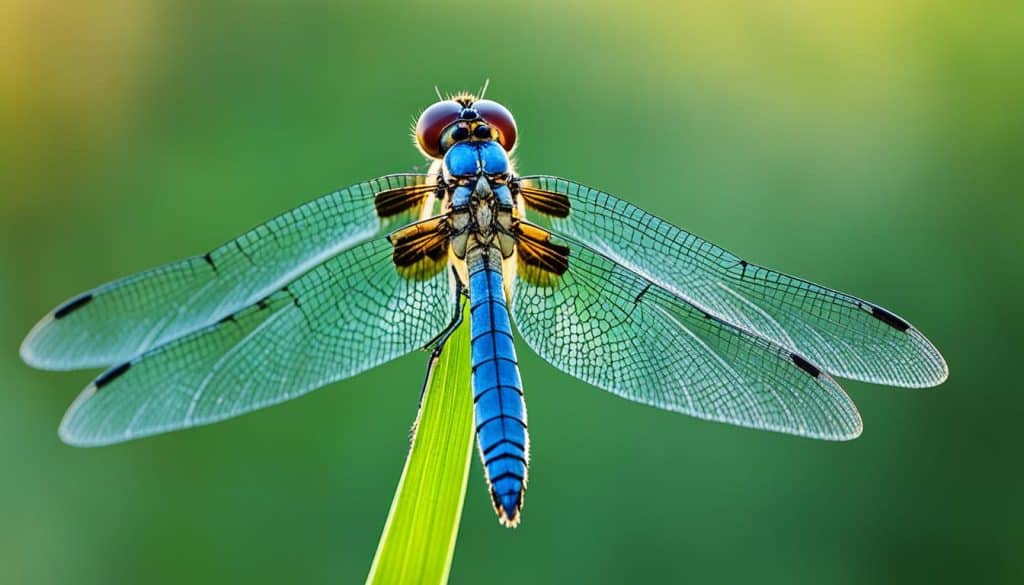
Composing Your Shot for Maximum Impact
How you arrange your shot is crucial for eye-catching macro insect photos. Use the rule of thirds to frame your subject. A clean background helps your insect stand out.
Use negative space to focus on details like compound eyes or wing patterns. Don’t hesitate to try unique angles or perspectives to make your shot stand out.
With these techniques, you’ll be able to take stunning macro insect photos. These photos will show the hidden beauty of the tiny world around us.
Conclusion
Exploring macro insects through close-up photography reveals their hidden beauty. This art form opens a window into a world full of tiny details and bright colors. It shows us the beauty we often miss.
We’ve learned about the key equipment, camera settings, and advanced techniques needed for macro photography. We now know how to capture the beauty of tiny insects. We’ve learned about depth of field and lighting to make our photos stand out.
Our skills in macro photography improve our art and help science. By documenting insects in detail, we expand our knowledge of the tiny creatures around us. Let’s keep exploring and sharing the beauty of macro insects with the world.
FAQ
What equipment do we need for macro insect photography?
How do we achieve a narrow depth of field in macro insect shots?
Why is lighting crucial for macro insect photography?
How do we compose impactful macro insect images?
What are the benefits of macro insect photography?
Source Links
- What are brown widow spiders and are they poisonous? – https://www.cbsnews.com/essentials/what-are-brown-widow-spiders/
- Genetically modified flies can reduce waste and keep it out of landfills – https://www.thebrighterside.news/post/genetically-modified-flies-can-reduce-waste-and-keep-it-out-of-landfills/
- A new plant excited conservationists. Then they found out it was aggressive. – https://www.thegazette.com/environment-nature/the-discovery-of-a-new-plant-at-a-johnson-county-park-was-exciting-until-conservationists-learned-m/
- Mobile Species Like Butterflies Strengthen the Different Habitats They Visit – https://www.technologynetworks.com/applied-sciences/news/mobile-species-like-butterflies-strengthen-the-different-habitats-they-visit-390118
- Why ticks are becoming an even bigger danger – https://www.uniondemocrat.com/lifestyle/article_cdf08260-601c-11ef-8317-af6a5188f54d.html
- Walmart and Walgreen’s Security Measures Anger Texas Shoppers – https://kpel965.com/walmart-and-walgreens-security-measures-anger-texas-shoppers/
- Assessment of Microstructural Features of a Silchrome 1 Exhaust Valve of a Harley-Davidson WLA World War II Motorcycle – https://www.mdpi.com/1996-1944/17/16/4156
- Both Maternal High-Fat and Post-Weaning High-Carbohydrate Diets Increase Rates of Spontaneous Hepatocellular Carcinoma in Aged-Mouse Offspring – https://www.mdpi.com/2072-6643/16/16/2805
- Assessing Elemental Diversity in Edible-Podded Peas: A Comparative Study of Pisum sativum L. var. macrocarpon and var. saccharatum through Principal Component Analysis, Correlation, and Cluster Analysis – https://www.mdpi.com/2311-7524/10/8/890
About The Author


