

Index of Contents
Have you ever gazed into a still lake on a crisp morning? The world seems to double before your eyes. Trees, sky, and mountains create a perfect mirror image on the water. This magical moment shows the beauty of reflection photography.
Encountering a perfect reflection can leave us in awe. It’s like nature is showing off its artistic side. Photographers get to capture and share these moments of symmetry and beauty with the world.
Reflection photography lets us create mirror effects that make our images stand out. By mastering this technique, we add depth and magic to our photos. Whether it’s a cityscape in a puddle or mountains in a lake, the possibilities are endless.
This guide will dive into the art of reflection photography. We’ll share tips to help you create stunning mirror effects. From the science behind reflections to choosing the right locations and equipment, we’ve got you covered to improve your photography skills.
Key Takeaways
- Reflection photography creates mirror-like images that double visual impact
- Understanding reflection science is crucial for mastering this technique
- Choosing the right locations is key to capturing stunning mirror effects
- Proper equipment enhances reflection photography results
- Mastering composition strategies is essential for creating captivating reflections
- Both natural and artificial reflections can be used in creative photography
Understanding the Art of Reflection Photography
Reflection photography makes beautiful images by capturing mirror-like scenes on various surfaces. It mixes technical skills with creative ideas. Let’s dive into the key parts of mastering reflection photography.
The Science Behind Reflections
Reflections happen when light hits smooth surfaces and bounces back. Water reflections are loved for their calmness and clarity. Knowing how light works helps photographers make stunning mirror effects. Calm waters, glass, and shiny metals are great for reflections.
Choosing the Right Locations for Mirror Effects
It’s important to find the best spots for reflection photos. Look for:
- Serene lakes and ponds
- Puddles after rainfall
- Reflective buildings in urban settings
- Polished floors in indoor spaces
These places are perfect for creating amazing mirror images.
Essential Equipment for Capturing Reflections
To get great shots, use top-notch photography gear:
- Camera with manual settings
- Sturdy tripod for stability
- Polarizing filters to control reflections
- Wide-angle lens for big scenes
https://www.youtube.com/watch?v=LxPr6m5V5tQ
| Equipment | Purpose | Impact on Reflection Photography |
|---|---|---|
| Camera with Manual Settings | Control exposure and focus | Allows precise adjustments for perfect reflections |
| Tripod | Stabilize camera | Ensures sharp, clear reflection images |
| Polarizing Filter | Manage reflections and glare | Enhances or reduces reflections as desired |
| Wide-Angle Lens | Capture expansive scenes | Ideal for landscape reflection photography |
Mastering these elements will help you take amazing reflection photos. These photos will amaze people and show off your artistic side.
Reflection Techniques: Mastering the Mirror Effect
Reflection techniques are key in creative photography. We’ll look into how to get amazing mirror effects in your photos. From how to set up your shot to adjusting your camera, these skills will boost your photography.
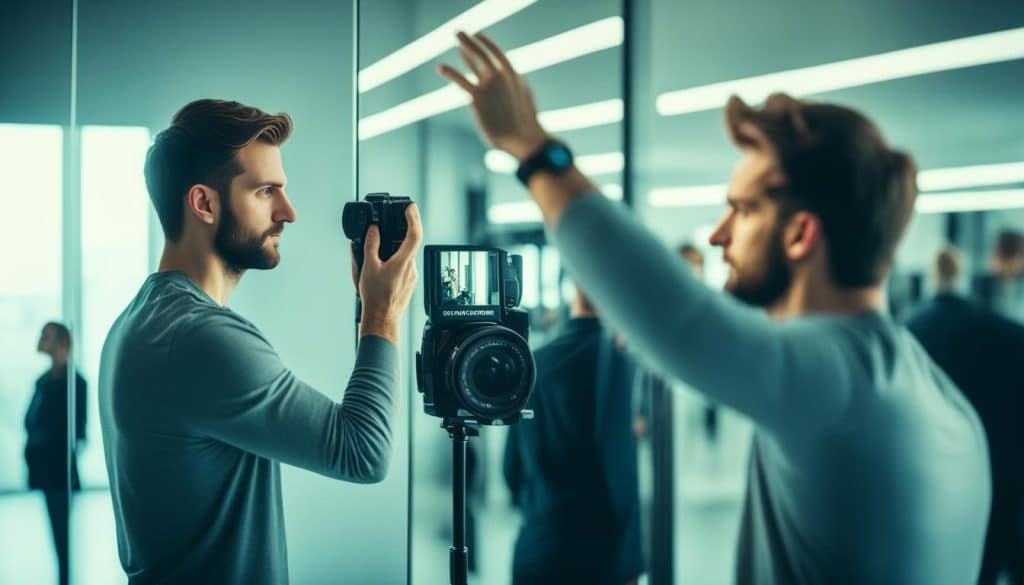
Composition Strategies for Stunning Reflections
To make great reflections, start with good composition. Place the horizon line at the top or bottom third of the frame using the rule of thirds. This makes your image balanced and draws the viewer’s eye.
Utilizing Natural Water Sources for Reflections
Nature is full of chances for reflection photography. Use lakes, rivers, or puddles as perfect mirrors. Try different angles to get the best reflection shots. Early morning or late evening work best, with calm waters and soft light.
Creating Artificial Reflections with Props
Don’t just stick to natural reflections. Mirrors, glass, or metallic surfaces can make cool artificial reflections. These props let you play with perspective and add something special to your photos. Place a mirror somewhere unexpected for surreal, eye-catching shots.
Adjusting Camera Settings for Perfect Mirror Images
Getting your camera settings right is key for clear reflections. Play with aperture to focus on both your subject and its reflection. Use a smaller aperture (higher f-number). Adjust your shutter speed to freeze or blur water movement. Practice is key to getting these settings right for reflection shots.
| Camera Setting | Effect on Reflection | Recommended Range |
|---|---|---|
| Aperture | Controls depth of field | f/8 – f/16 |
| Shutter Speed | Affects water movement | 1/60 – 1/250 sec |
| ISO | Adjusts light sensitivity | 100 – 400 |
Mastering these reflection techniques and camera settings will help you create stunning mirror effects in your photos. Don’t forget to try different angles and perspectives for unique shots.
Conclusion
We’ve looked into the world of reflection photography and its amazing mirror effects. This technique lets photographers make their shots look twice as good. By learning about reflection photography, we can turn simple scenes into stunning works of art.
This guide covered the basics of capturing reflections. We learned about the science behind them and how to pick the best spots. We also explored ways to make mirror-like images, like using water and props.
Reflection photography takes practice and trying new things. By using the tips on composition and camera settings, photographers can improve their work. The secret to great reflection photos is patience, creativity, and spotting unique chances to make mirror effects.
We hope this guide has sparked your interest in reflection photography and your creativity. With these tips, you can take amazing mirror-like photos that will impress everyone. So, pick up your camera, find reflective surfaces, and start making your own mirror effects!
FAQ
What is the science behind reflections?
What are the ideal locations for capturing reflections?
What essential equipment is needed for reflection photography?
How can I compose stunning reflection images?
How can I utilize natural water sources for reflections?
How can I create artificial reflections with props?
What camera settings should I adjust for perfect mirror images?
Source Links
- New Painkiller Could Bring Relief to Millions—Without Addiction Risk – https://www.scientificamerican.com/article/new-pain-medication-suzetrigine-prevents-pain-signals-from-reaching-brain/
- Ronan Bouroullec Transforms Ceramics Into Fabric With Adagio – https://design-milk.com/adagio-a-ronan-bouroullec-design-that-transforms-tiles-into-fabric-like-installations/
- Your Daily Horoscope for Aug. 22, According to ChatGPT – https://www.aol.com/daily-horoscope-aug-22-according-101200647.html
- The Strategic Mastermind Behind China’s Economic Surge – https://www.riotimesonline.com/the-strategic-mastermind-behind-chinas-economic-surge/
- ‘Hitting kids should never be allowed’: Illinois bans corporal punishment in all schools – https://buffalonews.com/news/nation-world/education/education-politics-children-well-being-psychology/article_00452813-5b59-5293-b19e-ba670afe2f2d.html
- ‘Emily in Paris’ is a masterclass in blending French and American beauty – https://www.harpersbazaar.com/uk/beauty/make-up-nails/a61932541/emily-in-paris-season-4-makeup-artist-interview/
- Vantage Markets Unveils Electrifying New Video Campaign to Ignite Copy Trading Excitement Among Young Traders – https://www.bastillepost.com/global/article/4093985-vantage-markets-unveils-electrifying-new-video-campaign-to-ignite-copy-trading-excitement-among-young-traders
- Satellite Solutions for Precision Viticulture: Enhancing Sustainability and Efficiency in Vineyard Management – https://www.mdpi.com/2073-4395/14/8/1862
- Coated Biodegradable Zinc Lithium Alloys: Development and Characterization of Co-Doped Strontium Copper Tricalcium Phosphate Coating for Antimicrobial Applications – https://www.mdpi.com/2079-6412/14/8/1073
- Luminescence Efficiency and Spectral Compatibility of Cerium Fluoride (CeF3) Inorganic Scintillator with Various Optical Sensors in the Diagnostic Radiology X-ray Energy Range – https://www.mdpi.com/2304-6740/12/8/230
About The Author


